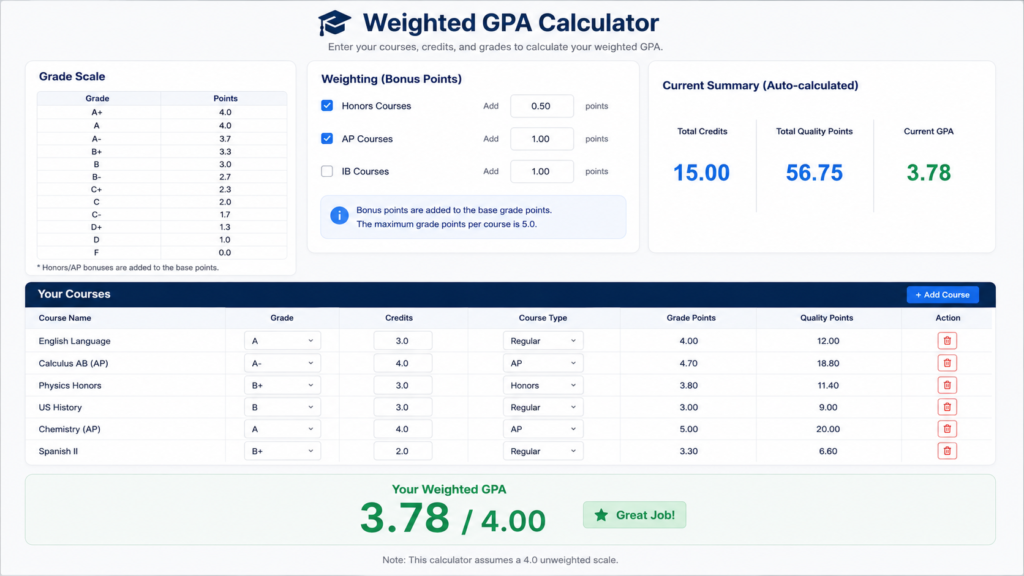
If your weighted GPA shows up as 4.3 or 4.6 and you’re wondering how that’s possible on a “4.0 scale,” you’ve discovered the most misunderstood part of the GPA system: weighting. Colleges want to see if you challenged yourself with AP, IB, or Honors classes — and weighted GPA is how schools try to reflect that on paper.
This page gives you a calculator built specifically for weighted GPA, plus the details competitor sites skip: how much each course type actually adds, why some schools cap the scale and others don’t, and why a college might recalculate your GPA anyway.
What Is Weighted GPA?
Weighted GPA is a GPA calculation that gives extra grade points for more rigorous courses (AP, IB, Honors) compared to standard-level classes, on the idea that an A in a harder course should count for more than an A in a regular one.
Weighted vs Unweighted — Quick Comparison
| Unweighted GPA | Weighted GPA | |
|---|---|---|
| Scale | Capped at 4.0 | Often uncapped, can exceed 4.0 |
| Course difficulty factored in? | No | Yes |
| Best for | Comparing raw grades regardless of course level | Reflecting course rigor |
How to Use Our Weighted GPA Calculator
- Enter each course, its credit hours, and the letter grade earned.
- Mark the course level — Standard, Honors, AP, or IB.
- Click Calculate to see your weighted GPA alongside the unweighted equivalent.
- Try “what if” scenarios by adding or changing a course level to see the projected impact.
The Weighted GPA Formula
Weighted GPA = Σ(Credit Hours × Weighted Grade Points) ÷ Σ(Credit Hours)
Common Bonus Point Conventions
| Course Level | Typical Bonus | Notes |
|---|---|---|
| Standard | +0.0 | Base 4.0 scale applies |
| Honors | +0.5 | Some schools use +1.0 instead |
| AP / IB | +1.0 | Some schools cap the final GPA regardless of bonus |
These conventions are set at the school-district level, not nationally — always confirm your school’s exact policy before comparing your number to a national benchmark.
Worked Example
| Course | Level | Credits | Grade | Unweighted Points | Weighted Points |
|---|---|---|---|---|---|
| AP Biology | AP | 3 | A | 4.0 | 5.0 |
| Honors Algebra II | Honors | 3 | A- | 3.7 | 4.2 |
| World History | Standard | 3 | B+ | 3.3 | 3.3 |
| Spanish II | Standard | 3 | A | 4.0 | 4.0 |
- Unweighted GPA = (4.0+3.7+3.3+4.0) ÷ 4 = 3.75
- Weighted GPA = (5.0+4.2+3.3+4.0) ÷ 4 = 4.13
Capped vs Uncapped Weighted GPA
Some schools cap weighted GPA at a maximum (commonly 4.5 or 5.0) regardless of how many AP/IB classes a student takes, while others leave it uncapped, allowing GPA to climb higher the more advanced courses a student completes. This is one of the biggest reasons two students with similar course loads can report very different weighted GPAs — it’s a school policy difference, not a reflection of actual performance difference.
“What If” Scenario: Adding One More AP Class
Using the same transcript above, suppose the student swaps Spanish II (Standard, A) for AP Spanish (AP, A):
| Course | Level | Credits | Grade | Weighted Points |
|---|---|---|---|---|
| AP Biology | AP | 3 | A | 5.0 |
| Honors Algebra II | Honors | 3 | A- | 4.2 |
| World History | Standard | 3 | B+ | 3.3 |
| AP Spanish | AP | 3 | A | 5.0 |
- New Weighted GPA = (5.0+4.2+3.3+5.0) ÷ 4 = 4.38, up from 4.13
That’s the kind of modeling our calculator lets you run before you actually commit to a course schedule.
Why Colleges Sometimes Recalculate Your GPA
Many colleges don’t take your school-reported weighted GPA at face value. Instead, admissions offices often recalculate GPA using their own standardized formula — sometimes only counting core academic courses, sometimes applying their own weighting scale — specifically so they can compare applicants from different high schools on equal footing, since weighting conventions vary so much school to school. This is why your school-reported GPA and the number a college cites back to you can differ.
What Is a Good Weighted GPA?
- 4.5+ (uncapped scale): Highly competitive, reflects a heavy AP/IB course load with strong grades
- 4.0–4.4: Strong, reflects solid performance with some advanced coursework
- 3.5–3.9: Good, competitive for many selective schools
- Below 3.3: May limit options at the most selective schools, though still meets many standard admission thresholds
Because capped/uncapped scales vary, always check whether the benchmark you’re comparing against uses the same convention as your school.
Common Mistakes
- Comparing weighted GPA across schools without accounting for capped vs uncapped scales
- Assuming AP and Honors always get the same bonus (+1.0 vs +0.5 varies by school)
- Reporting only the weighted number on applications that ask for both
- Not anticipating that a college may recalculate GPA using its own formula
Tips for Balancing Rigor and GPA
- Understand your specific school’s bonus convention before planning your course schedule around GPA impact
- Don’t assume more AP classes always means a strictly higher weighted GPA — grades still matter more than the bonus itself
- Report both weighted and unweighted GPA when an application allows it, since colleges may use either
- Model “what if” scenarios before finalizing next semester’s course selections
FAQs
How much does an AP class raise your GPA? Typically by the school’s designated bonus (commonly +1.0 grade point), though the exact value varies by school district.
Is a 4.5 weighted GPA good? Yes, generally strong — but whether it’s competitive depends on whether your school’s scale is capped or uncapped, since a 4.5 on a capped 4.5 scale means something different than a 4.5 on an uncapped scale.
Do colleges look at weighted or unweighted GPA? Many look at both, and a significant number recalculate GPA using their own formula rather than relying solely on either number as reported by your school.
Why is my weighted GPA higher than 4.0? Because weighted GPA adds bonus points for AP, IB, or Honors courses, which can push the total above the traditional 4.0 unweighted ceiling.
Key Takeaways
- Weighted GPA reflects course rigor, not just grades — AP/IB/Honors classes typically add bonus points
- Bonus conventions (+0.5 vs +1.0) and capped/uncapped scales are set at the school level, not standardized nationally
- Colleges frequently recalculate GPA using their own formula for fair comparison across applicants
- Model “what if” scenarios before choosing next semester’s course load
Related Tools
- GPA Calculator
- CGPA Calculator
- SGPA Calculator
Call To Action
Use the free Weighted GPA Calculator above to see your exact weighted and unweighted GPA side by side, plus model how adding an AP or Honors class would change it.
Leave a Reply