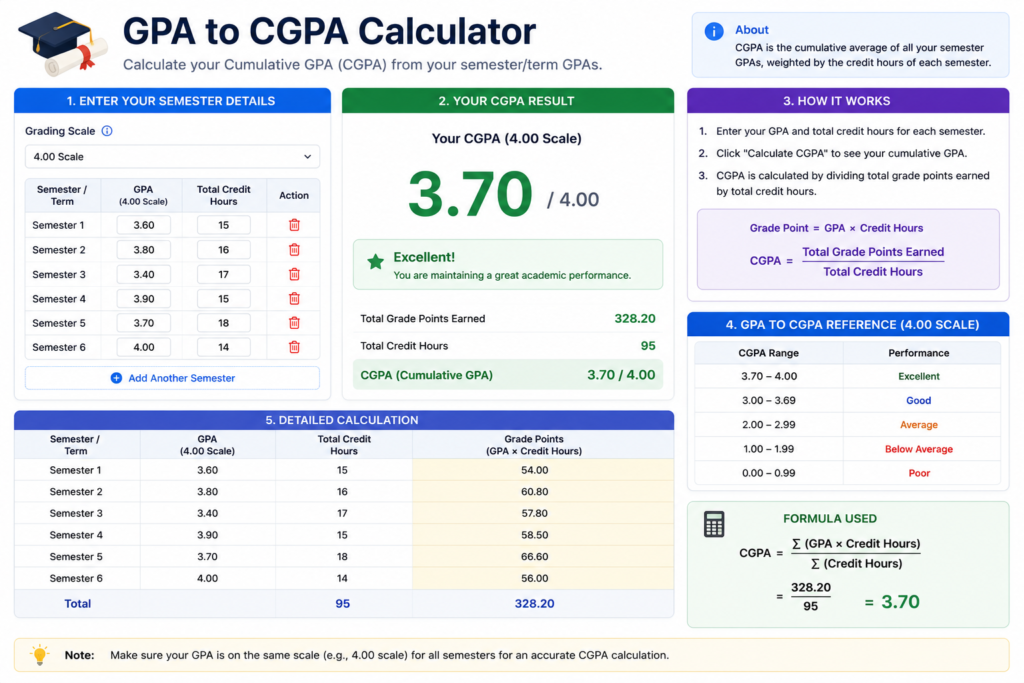
If you’re a student trying to understand how your semester-wise GPA (Grade Point Average) adds up into your overall CGPA (Cumulative Grade Point Average), you’re not alone. Thousands of students search for a reliable GPA to CGPA calculator every semester — especially when applying for higher studies, scholarships, or job applications that require a cumulative score instead of a single-semester grade.
This guide breaks down exactly how to convert GPA to CGPA, gives you the formula, walks through real examples, and explains where this calculation is different from a plain GPA calculation or a Percentage-to-CGPA conversion.
What Is GPA vs CGPA?
Before converting, it helps to know the difference:
| Term | Full Form | What It Measures |
|---|---|---|
| GPA | Grade Point Average | Your average grade points for a single semester or term |
| CGPA | Cumulative Grade Point Average | Your average grade points across all semesters/years completed so far |
In short: GPA is a snapshot, CGPA is the running average. Your CGPA is essentially the cumulative result of all your individual semester GPAs combined.
GPA to CGPA Formula
The most common and widely used formula to convert GPA to CGPA is:
CGPA = (Sum of GPA of all semesters) / (Total number of semesters)
If each semester carries different credit hours, use the credit-weighted formula for more accuracy:
CGPA = Σ (GPA of semester × Credit hours of semester) / Σ (Total credit hours)
This weighted method is more accurate because it accounts for semesters where you took more or fewer courses.
How to Calculate CGPA From GPA — Step by Step
- List your GPA for every completed semester.
- Note the credit hours for each semester (if your institution weighs semesters differently).
- Multiply each semester’s GPA by its credit hours (skip this step if using the simple average method).
- Add up all the weighted GPA values (or just the GPA values for the simple method).
- Divide by the total number of semesters (or total credit hours for the weighted method).
- The result is your CGPA, usually expressed on a 4.0 or 10-point scale depending on your institution.
Solved Examples
Example 1: Simple Average Method
A student has the following semester GPAs:
| Semester | GPA |
|---|---|
| Semester 1 | 8.2 |
| Semester 2 | 7.8 |
| Semester 3 | 8.5 |
| Semester 4 | 8.0 |
CGPA = (8.2 + 7.8 + 8.5 + 8.0) / 4 = 32.5 / 4 = 8.125
So the student’s CGPA is 8.13 (rounded to two decimals).
Example 2: Credit-Weighted Method
| Semester | GPA | Credit Hours | GPA × Credits |
|---|---|---|---|
| Semester 1 | 8.2 | 20 | 164 |
| Semester 2 | 7.8 | 18 | 140.4 |
| Semester 3 | 8.5 | 22 | 187 |
| Semester 4 | 8.0 | 20 | 160 |
Total credits = 80, Total weighted GPA = 651.4
CGPA = 651.4 / 80 = 8.14
Notice how the weighted method gives a slightly different (and more precise) result than the simple average.
GPA to CGPA Conversion Table (Quick Reference)
| Average GPA (across semesters) | Approx. CGPA (10-point scale) | Approx. Percentage |
|---|---|---|
| 9.0 – 10.0 | 9.0 – 10.0 | 85% – 100% |
| 8.0 – 8.9 | 8.0 – 8.9 | 76% – 84% |
| 7.0 – 7.9 | 7.0 – 7.9 | 66% – 75% |
| 6.0 – 6.9 | 6.0 – 6.9 | 56% – 65% |
| 5.0 – 5.9 | 5.0 – 5.9 | 46% – 55% |
Note: These figures are approximate general references. Always check your university’s official conversion policy, as scales vary between institutions (4.0 scale in the US, 10-point scale in India, etc.).
GPA to CGPA vs Percentage to CGPA: What’s the Difference?
It’s easy to confuse these two conversions, so here’s a quick clarification:
- GPA to CGPA takes multiple already-calculated semester GPA values and averages them (with or without credit weighting) to find your cumulative score.
- Percentage to CGPA works in reverse of a different kind — it converts a single percentage score into an equivalent CGPA value, typically using a formula like
CGPA = Percentage / 9.5(common in Indian CBSE-based systems).
In other words:
- Percentage to CGPA → converts one number’s scale (percentage → CGPA)
- GPA to CGPA → converts many numbers into one cumulative number (multiple GPAs → CGPA)
These are fundamentally different calculations, even though both involve “CGPA” in the name.
Why Accurate GPA to CGPA Conversion Matters
- Higher education applications: Many universities abroad ask for CGPA instead of semester-wise GPA.
- Scholarship eligibility: Cutoffs are often defined in CGPA terms.
- Job applications: Recruiters and HR systems frequently request a single cumulative score.
- Tracking academic progress: Seeing your CGPA trend helps you understand whether your performance is improving or declining over time.
Common Mistakes to Avoid
- Ignoring credit hours when semesters have different course loads — this skews the real CGPA.
- Mixing grading scales — don’t average a 4.0-scale GPA with a 10-point-scale GPA without converting both to the same scale first.
- Forgetting failed or repeated courses, which some institutions still factor into CGPA calculations.
- Rounding too early — round only your final CGPA, not intermediate GPA values, for better accuracy.
Frequently Asked Questions (FAQs)
Q1. Is CGPA just the average of all GPAs? Yes, in the simplest method, CGPA is the average of all semester GPAs. However, most universities use a credit-weighted average for more accurate results.
Q2. Can CGPA be higher than GPA? Yes. If your recent semesters had a higher GPA than earlier ones, your CGPA could end up close to or interpolated between your best and weakest semesters, depending on the weighting.
Q3. What is a good CGPA? This depends on the scale and institution, but generally, a CGPA above 8.0 (on a 10-point scale) or above 3.5 (on a 4.0 scale) is considered strong.
Q4. Does GPA to CGPA conversion differ by country? Yes. The US typically uses a 4.0 scale, India commonly uses a 10-point scale, and some countries use percentage-based systems — always confirm your institution’s specific method.
Q5. How is this different from a GPA calculator? A GPA calculator computes your grade average for a single semester based on your course grades and credit hours. A GPA to CGPA calculator takes those semester-level GPA results and combines them into one cumulative score across your entire academic record.
Conclusion
Converting GPA to CGPA doesn’t have to be confusing once you understand the underlying formula. Whether you use the simple average method or the more accurate credit-weighted method, the key is consistency — use the same scale, include all completed semesters, and check your institution’s specific conversion rules before submitting your CGPA for applications or scholarships.
Ready to calculate? Plug your semester GPAs into the formula above, or use an online GPA to CGPA calculator tool for instant results.
Leave a Reply