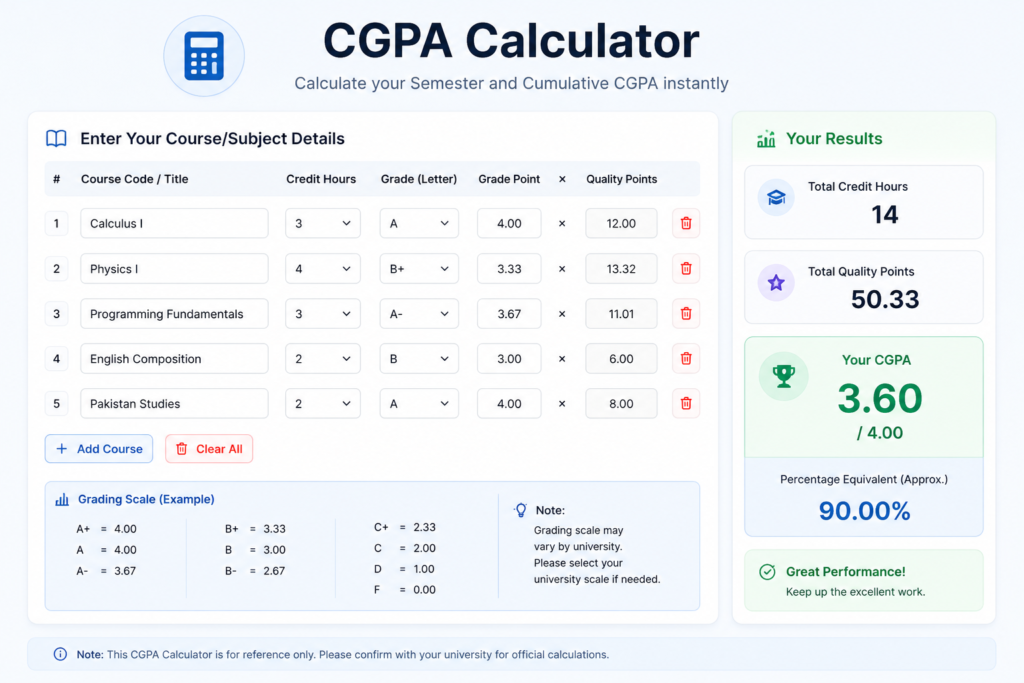
If you’ve ever stared at your transcript wondering exactly how that CGPA number was calculated — or panicked because a job application wants your “percentage” and you only have a CGPA — you’re not alone. It’s one of the most common points of confusion for students in India, Pakistan, and several other countries that use the 10-point grading system.
This guide gives you a free calculator to get your CGPA in seconds, plus a full, plain-English breakdown of the formula, the conversions, and the exceptions nobody tells you about — like how backlogs are treated, and why your friend’s “9.5 multiplier” doesn’t apply to your university.
A quick honesty note before we start: there is no single universal CGPA-to-percentage formula. Every university and grading board sets its own conversion rule. We’ll show you the most common ones and how to find yours, rather than pretending one formula fits everyone.
What Is CGPA? (Definition)
CGPA (Cumulative Grade Point Average) is the average of grade points a student earns across all semesters or years of a course, weighted by the credit hours of each subject. Unlike a single semester’s performance (SGPA), CGPA reflects your overall academic record from the start of the program to the current point.
CGPA vs GPA vs SGPA vs Percentage
These four terms get mixed up constantly. Here’s the difference in one table:
| Term | Full Form | Scope | Common Region |
|---|---|---|---|
| GPA | Grade Point Average | Usually cumulative, per term or overall | US, UK, global |
| SGPA | Semester Grade Point Average | One semester only | India, South Asia |
| CGPA | Cumulative Grade Point Average | All semesters combined | India, South Asia, Middle East |
| Percentage | — | Marks out of 100 | India (older system), many exam boards |
In short: SGPA is a snapshot, CGPA is the full movie. GPA is the term used internationally for roughly the same concept as CGPA, though scales differ (4.0 vs 10.0 being the two most common).
How to Use Our CGPA Calculator
- Select your grading scale — 10-point, 4-point, or percentage-based.
- Enter each subject’s credit hours and the grade point you earned.
- Add all semesters you want included (for cumulative CGPA) or just one (for SGPA).
- Click Calculate — the tool multiplies each grade point by its credit hours, sums them, then divides by total credits.
- View your CGPA and percentage equivalent side by side, with the formula shown so you can verify it manually.
CGPA Formula: How CGPA Is Calculated
The standard formula used by most 10-point-scale universities is:
CGPA = Σ(Credit Hours × Grade Point) ÷ Σ(Credit Hours)
Worked Example (Single Semester)
Say you took 4 subjects this semester:
| Subject | Credits | Grade Point |
|---|---|---|
| Math | 4 | 9 |
| Physics | 3 | 8 |
| Chemistry | 3 | 7 |
| English | 2 | 9 |
- Total (Credits × Grade Point) = (4×9) + (3×8) + (3×7) + (2×9) = 36 + 24 + 21 + 18 = 99
- Total Credits = 4+3+3+2 = 12
- SGPA = 99 ÷ 12 = 8.25
Multi-Semester CGPA Example
Now imagine you want your cumulative CGPA after 4 semesters, and each semester had a different SGPA and total credit load:
| Semester | SGPA | Total Credits |
|---|---|---|
| 1 | 8.2 | 20 |
| 2 | 7.8 | 22 |
| 3 | 8.5 | 21 |
| 4 | 8.0 | 20 |
- Total (SGPA × Credits) = (8.2×20)+(7.8×22)+(8.5×21)+(8.0×20) = 164+171.6+178.5+160 = 674.1
- Total Credits = 20+22+21+20 = 83
- CGPA = 674.1 ÷ 83 = 8.12
This is why you can’t just average your four SGPAs (8.2+7.8+8.5+8.0)/4 = 8.125 — it happens to be close here, but it drifts further apart the more your credit loads vary semester to semester. Always weight by credits, not a simple average.
How to Convert CGPA to Percentage
This is the single most-searched question around CGPA — and the one competitor sites answer least clearly. The honest answer: it depends entirely on your university or board’s official formula.
Common Multipliers (verify against your institution’s official circular)
| Multiplier | Formula | Commonly Associated With |
|---|---|---|
| 9.5 | Percentage = CGPA × 9.5 | Widely cited “CBSE-style” approximation for 10-point scale |
| 10 | Percentage = CGPA × 10 | Simple flat conversion some universities use |
| 9.4 | Percentage = CGPA × 9.4 | Used by some specific university grading policies |
| Custom | (CGPA − 0.75) × 10 | Some engineering universities’ internal formulas |
Example: A CGPA of 8.25 →
- Using ×9.5: 8.25 × 9.5 = 78.4%
- Using ×10: 8.25 × 10 = 82.5%
Notice the nearly 4-point gap between the two results. This is exactly why you should confirm your university’s official multiplier before submitting a percentage figure to an employer or foreign university — never assume the ×9.5 rule applies by default.
CGPA Scales Around the World
India
Most Indian universities under UGC/AICTE frameworks use a 10-point scale, with grade points typically ranging from 0–10 mapped to letter grades (O, A+, A, B+, B, C, etc.).
Pakistan
Pakistani universities often use a 4.0 GPA scale for undergraduate programs, alongside a percentage system for board exams (matric/intermediate).
United States
US institutions almost universally use a 4.0 GPA scale, where A=4.0, B=3.0, and so on, and the term “CGPA” is less common — “cumulative GPA” is used instead but calculated the same way (credit-weighted average).
UK-Style Systems
Many Commonwealth-influenced universities use classification bands (First Class, Upper Second, Lower Second, Third) instead of a numeric CGPA, though internal credit-weighted averages often exist behind the scenes.
What Is a Good CGPA?
There’s no single cutoff, but general benchmarks that recur across admissions and hiring contexts:
- 9.0+ (10-point scale) / 3.7+ (4-point scale): Excellent, competitive for top scholarships and research programs
- 8.0–8.9 / 3.3–3.6: Strong, well above average for most graduate admissions
- 7.0–7.9 / 3.0–3.2: Solid, meets most standard eligibility cutoffs
- Below 6.5 / below 2.5: May limit eligibility for some competitive programs — check specific program requirements
These are general reference bands, not official cutoffs — always check the specific minimum CGPA required by the program or employer you’re applying to.
Does CGPA Include Backlogs or Failed Subjects?
This trips up a lot of students. In most credit-weighted systems:
- A failed subject typically carries a grade point of 0 (or below the passing threshold), and it is still included in the total credit count for that semester’s calculation — dragging the average down.
- Once you clear the backlog, many universities recalculate CGPA using the improved grade, replacing the failing grade point rather than averaging the fail and the pass together — but this rule varies significantly by institution.
- Some universities exclude backlog subjects from CGPA entirely until cleared, then insert the passing grade retroactively.
Bottom line: check your university’s examination handbook. This is one of the least standardized parts of CGPA calculation.
Common Mistakes When Calculating CGPA
- Averaging SGPAs directly instead of weighting by credit hours
- Using the wrong multiplier (×9.5 vs ×10) when converting to percentage
- Forgetting to include a semester with fewer credits, which skews the “simple average” method
- Assuming all universities use the same 10-point scale
- Not accounting for backlog/repeat-subject rules specific to their institution
Tips to Improve Your CGPA
- Prioritize high-credit subjects — they carry more weight in the formula
- Address backlogs early, since failing grades often stay factored into your credit total until cleared
- Track your running CGPA every semester rather than only at graduation, so you know exactly what final GPA you need in remaining semesters
- Confirm your university’s exact conversion formula early, especially if you’ll need a percentage figure for job or visa applications
CGPA Calculator vs Manual Calculation: Which Is More Reliable?
A calculator is only as reliable as the formula behind it. Ours shows the full formula and intermediate math so you can verify every step — which matters, because many calculators online silently assume a ×9.5 multiplier or an unweighted average, both of which can be wrong for your specific university. Manual calculation is more reliable only if you already know your institution’s exact rules; otherwise, a transparent calculator that shows its work is the safer bet.
FAQs
What is the full form of CGPA? CGPA stands for Cumulative Grade Point Average — the credit-weighted average of grade points across all semesters of a program.
How is CGPA calculated with an example? Multiply each subject’s credit hours by its grade point, sum those values across all subjects and semesters, then divide by the total credit hours. For example, 99 total grade points across 12 credits gives an SGPA of 8.25.
Is 8 CGPA good? On a 10-point scale, an 8.0 CGPA is generally considered strong — above average for most graduate admissions and many job eligibility cutoffs, though “good” ultimately depends on your field and target program.
How do I convert CGPA to percentage? Multiply your CGPA by the conversion factor your university officially uses — commonly 9.5 or 10 — but always confirm the exact multiplier with your institution, since it varies.
What is the difference between CGPA and SGPA? SGPA reflects performance in a single semester; CGPA is the cumulative, credit-weighted average across all semesters completed so far.
Does CGPA reset every semester? No. SGPA is calculated fresh each semester, but CGPA accumulates across all semesters and is recalculated as a running average each time a new semester’s grades are added.
Leave a Reply