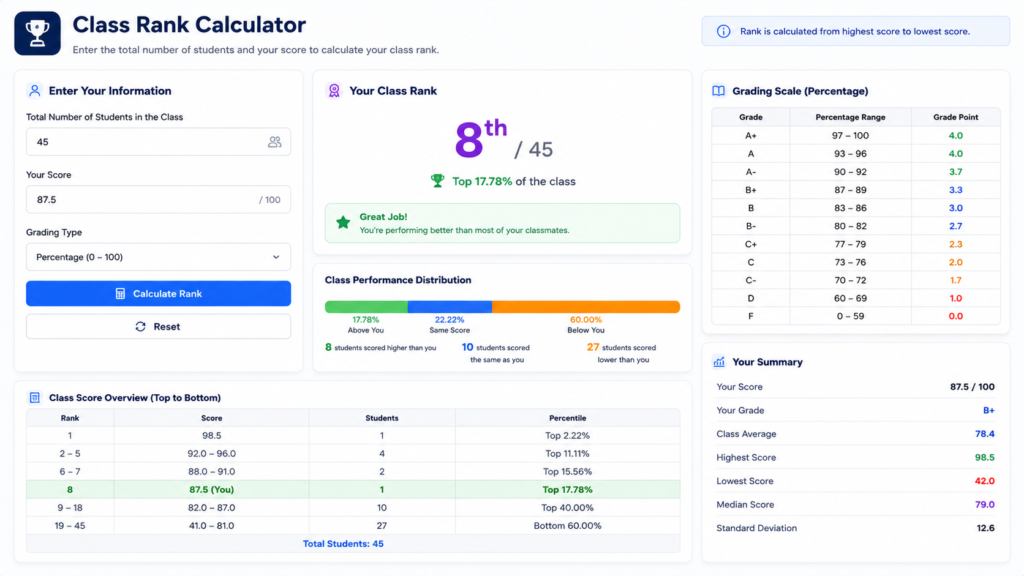
College applications sometimes ask for a specific rank number, sometimes a percentile, and sometimes nothing at all — because a growing number of high schools have quietly stopped reporting class rank altogether. If you’re trying to figure out where you stand, or how to translate a rank number into the percentile a form is actually asking for, this page walks through both.
What Is Class Rank?
Class rank is a student’s academic standing relative to their entire graduating class, typically determined by GPA (weighted, unweighted, or a school-specific formula) and expressed as a position (e.g., “15th out of 320”) or a percentile.
How to Use Our Class Rank Calculator
- Enter your GPA (weighted or unweighted, matching whichever your school uses for ranking).
- Enter your class size (total number of students in your graduating class).
- Enter your known or estimated rank number, if available.
- Click Calculate to see your percentile equivalent.
How Class Rank Is Calculated
Most schools rank students by sorting the entire graduating class by GPA (often weighted GPA specifically) from highest to lowest, then assigning each student a sequential position.
Worked Example
If a class has 300 students and a student’s GPA places them 24th highest in that sorted list, their class rank is simply 24th out of 300.
How to Convert Class Rank to Percentile
Percentile = 100 − [(Rank − 1) ÷ Class Size × 100]
Worked Conversion Example
Using the example above (24th out of 300):
- (24 − 1) ÷ 300 × 100 = 23 ÷ 300 × 100 = 7.67
- Percentile = 100 − 7.67 = 92.3rd percentile, meaning this student is in roughly the top 8% of their class
Weighted vs Unweighted GPA: How It Changes Your Rank
Because weighted GPA gives bonus points for AP/IB/Honors courses, a student’s rank can differ depending on which GPA their school uses for ranking purposes. A student with fewer AP classes but excellent grades might rank higher on an unweighted scale than on a weighted one, where students with heavier course loads gain an edge. Always confirm which GPA your school actually uses to rank students — it’s not automatically the same one printed at the top of your transcript.
Why Some Schools No Longer Report Class Rank
A number of high schools have moved away from officially reporting class rank in recent years, citing concerns that ranking can create unhealthy competition among students taking different course loads, or that it doesn’t fairly reflect students who pursue depth in fewer subjects versus breadth across many. Others continue reporting rank because some scholarship programs and state university systems specifically require it for eligibility. This varies significantly district to district, so check your own school’s specific policy rather than assuming either approach is universal.
What to Do If Your School Doesn’t Report Rank
- Check if your school provides a decile or quartile range instead of an exact number (many schools that stop full ranking still offer this)
- Ask your school counselor whether an official “class profile” document exists, which colleges often use in place of individual rank
- If a scholarship or application specifically requires rank and your school doesn’t provide one, your counselor can typically write a note confirming your school’s non-ranking policy
What Is a Good Class Rank/Percentile?
- Top 10% (90th percentile+): Highly competitive for selective college admissions and many merit scholarships
- Top 25% (75th percentile+): Strong, meets many scholarship and admission benchmarks
- Top 50%: Solid, meets standard eligibility for many programs
- Context matters enormously here — a rank at a highly competitive school carries different weight than the same rank at a less competitive one, which is part of why many colleges look at the full academic context rather than rank alone
Common Mistakes
- Assuming class rank always uses weighted GPA when some schools use unweighted, or a separate formula entirely
- Converting rank to percentile incorrectly by not accounting for the “rank minus one” adjustment
- Assuming every school still reports an official rank
- Reporting an estimated/self-calculated rank as if it were official on a formal application
FAQs
How is class rank determined? Most schools sort the entire graduating class by GPA (weighted or unweighted, depending on school policy) and assign each student a sequential rank position based on that order.
What percentile is top 10% of class rank? Top 10% corresponds to the 90th percentile or higher — meaning the student outperforms at least 90% of their graduating class.
Do colleges care about class rank if my school doesn’t report it? Many colleges account for this by reviewing a school’s “class profile” instead, and generally don’t penalize applicants from non-ranking schools, though policies vary by institution.
Is class rank based on weighted or unweighted GPA? It depends on the school — some use weighted GPA specifically to account for course rigor, others use unweighted, so check your school’s specific ranking policy.
Key Takeaways
- Class rank is a relative measure — your position depends on your entire class’s GPA distribution, not GPA alone
- Converting rank to percentile follows a simple formula, useful when an application asks for one but not the other
- Whether your school uses weighted or unweighted GPA for ranking changes the outcome — confirm which one applies
- A growing number of schools no longer report official rank — check your specific school’s policy rather than assuming
Related Tools
- Weighted GPA Calculator
- GPA Calculator
- CGPA Calculator
- Grade Calculator
Call To Action
Use the free Class Rank Calculator above to estimate your percentile standing instantly — and pair it with our Weighted GPA Calculator to see exactly how your course load factors in.
Leave a Reply