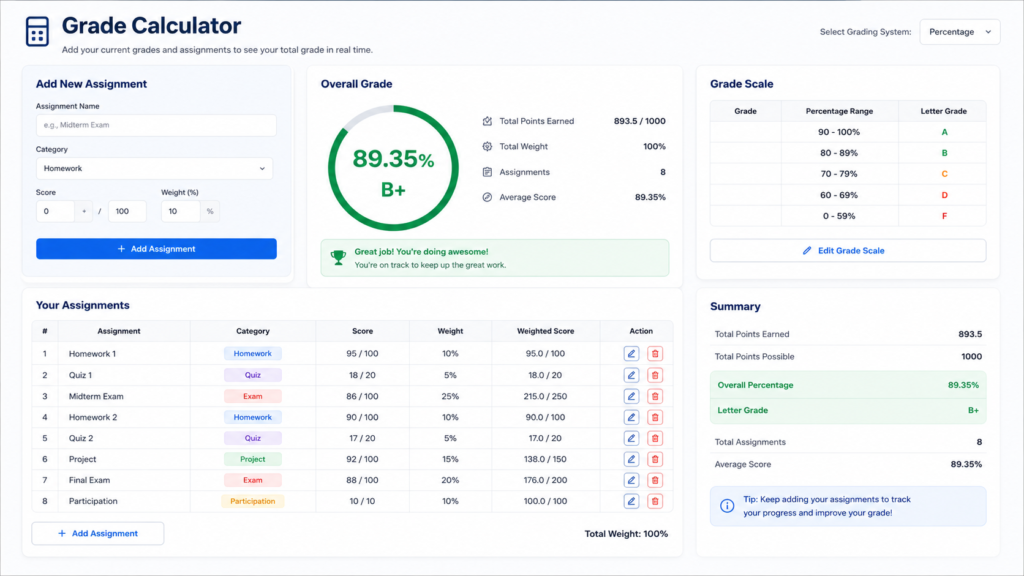
It’s the night before your final exam, and you’re doing math in your head trying to figure out exactly what score keeps your grade where you need it. That calculation is more precise than most people realize — and getting it wrong in either direction means either needless panic or a nasty surprise.
This page gives you a calculator for your current weighted grade, plus the reverse calculation everyone actually searches for at 11pm: what score do I need on this final?
What Is a Weighted Course Grade?
A weighted course grade combines scores from different categories (homework, quizzes, exams, participation, final exam) according to percentages set in the course syllabus, rather than treating every assignment equally. A homework category worth 10% of the grade affects your final number far less than an exam category worth 40%, even if you score the same percentage in both.
How to Use Our Grade Calculator
- Enter each grading category (e.g., Homework, Quizzes, Midterm, Final) and its weight percentage from your syllabus.
- Enter your current score in each category.
- Click Calculate to see your current overall grade.
- Switch to “Grade Needed” mode, enter your target grade, and the calculator solves for the score you need on the remaining category (like your final exam).
The Weighted Grade Formula
Overall Grade = Σ(Category Score × Category Weight)
Worked Example (Multiple Categories)
| Category | Weight | Your Score |
|---|---|---|
| Homework | 15% | 92% |
| Quizzes | 15% | 85% |
| Midterm Exam | 25% | 78% |
| Participation | 5% | 100% |
| Final Exam | 40% | ? (not yet taken) |
Before the final, your grade so far (out of the 60% already completed) is:
- (92×0.15) + (85×0.15) + (78×0.25) + (100×0.05) = 13.8 + 12.75 + 19.5 + 5 = 51.05 out of a possible 60
How to Calculate the Score You Need on Your Final
This is the reverse calculation: you know your target overall grade, and you need to solve for the missing category’s score.
Score Needed = (Target Grade − Points Already Earned) ÷ Remaining Weight
Worked Reverse-Calculation Example
Using the same course above, suppose you want an overall grade of 85%, and the final exam is worth 40%:
- Target grade = 85
- Points already earned = 51.05 (from the 60% completed so far)
- Remaining weight = 40% (0.40)
- Score Needed = (85 − 51.05) ÷ 0.40 = 33.95 ÷ 0.40 = 84.9%
So you’d need roughly an 85% on your final exam to land at an overall 85% — which is useful to know well before exam day, not after.
How a Zero or Missing Assignment Affects Your Grade
A missed assignment recorded as a zero is mathematically different from simply having “one less assignment counted” — a zero drags down the average using the assignment’s full weight, exactly like any other score would, just at the bottom of the scale. This is why one missed assignment in a heavily-weighted category can hurt more than several low (but non-zero) scores spread across lighter categories. If your instructor allows a makeup or drop policy for missed work, that changes this math significantly — always check your syllabus for that specific rule.
Letter Grade Ranges
| Percentage | Typical Letter Grade |
|---|---|
| 93–100 | A |
| 90–92 | A- |
| 87–89 | B+ |
| 83–86 | B |
| 80–82 | B- |
| 77–79 | C+ |
| 70–76 | C |
| 60–69 | D |
| Below 60 | F |
These ranges are a common convention, not universal — always check your specific syllabus, since some instructors use different cutoffs (e.g., 90 = A instead of A-).
How Dropped-Lowest-Score and Extra Credit Rules Work
- Dropped lowest score: If your syllabus states the lowest quiz or homework score is dropped, that score is excluded entirely from the category average before weighting is applied — recalculate the category average using only the remaining scores.
- Extra credit: Typically added as bonus points either to a specific category’s total or directly to the overall percentage, depending on how the instructor structures it — check whether it’s applied before or after category weighting, since that changes the math.
Common Mistakes
- Treating all assignments as equally weighted when the syllabus specifies different category weights
- Assuming a missed assignment is excluded rather than counted as a zero
- Using a generic letter-grade scale instead of the specific one in your syllabus
- Forgetting to recalculate the category average correctly when a lowest score is dropped
- Solving the “grade needed” calculation using the wrong remaining weight percentage
Tips for Managing Your Grade Throughout the Semester
- Recalculate your running grade after every major assignment, not just before finals
- Know your remaining weight percentage early, so a “what do I need” calculation is accurate when you actually need it
- Clarify your instructor’s zero/missing-assignment and drop policies at the start of the semester, not after it becomes relevant
- Use the reverse calculator well before exam day to set a realistic target score, not the night before
FAQs
What grade do I need on my final to get a B? It depends on your current grade and the final’s weight — use the formula: (Target Grade − Points Already Earned) ÷ Remaining Weight, plugging in your specific syllabus numbers.
How do you calculate a weighted grade average? Multiply each category’s score by its weight percentage, then sum all the weighted values to get your overall grade.
Does a zero average into your grade or count as missing? In most grading systems, a zero is averaged in at full category weight just like any other score — it does not simply disappear from the calculation unless your syllabus explicitly excludes missed work.
What percentage is a C+? Commonly 77–79%, though exact ranges vary by instructor and institution — always confirm against your specific syllabus.
Key Takeaways
- Weighted grades are calculated by multiplying each category’s score by its weight, not by simple averaging
- The “grade needed on final” calculation is a straightforward reverse of the weighted formula — solve for the missing score using your remaining weight
- A zero counts at full weight, unlike a genuinely dropped or excused assignment
- Always confirm your specific syllabus’s letter-grade ranges, drop policies, and extra credit rules, since these vary by instructor
Related Tools
- GPA Calculator
- Weighted GPA Calculator
- CGPA Calculator
- SGPA Calculator
Call To Action
Use the free Grade Calculator above to check your current course grade — or switch to “Grade Needed” mode to find out exactly what score you need on your next exam.
Leave a Reply