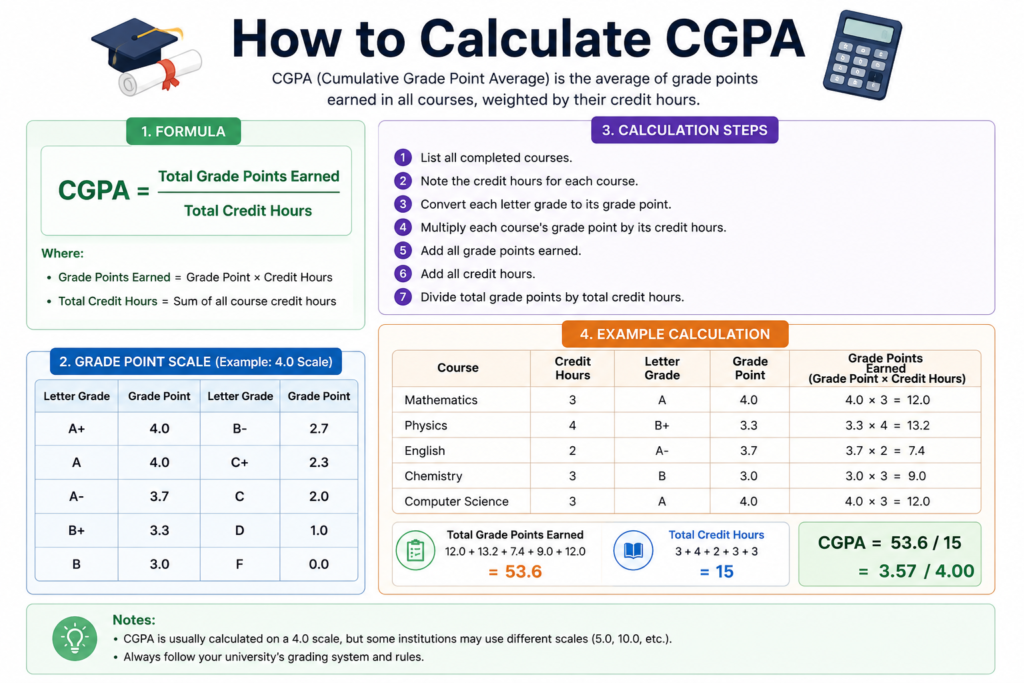
If your transcript shows a CGPA and you’re not totally sure how that number got there, you’re not alone. Most students see the term long before anyone explains the math behind it — and then end up guessing whether a rough semester actually hurt as much as it felt like it did.
Here’s the good news: CGPA is one of the simplest calculations in your entire academic record. Once you’ve done it by hand once, you’ll never wonder about it again.
What Is CGPA?
CGPA stands for Cumulative Grade Point Average. It’s a single number that summarizes your academic performance across all the courses you’ve taken so far — not just one semester, but your entire academic career up to that point.
Where a single-semester grade point average (SGPA) only looks at one term, CGPA rolls every semester together into one running average. That’s why it’s the number most universities put on your final transcript, and the number scholarship committees and employers usually ask for.
The CGPA Formula
At its core, CGPA is a credit-weighted average of the grade points you’ve earned. The formula is:
CGPA = (Sum of [Grade Point × Credit Hours] for every course) ÷ (Sum of all Credit Hours)That “credit-weighted” part matters. A 3-credit course counts three times as much toward your CGPA as a 1-credit course — so a strong grade in a heavy course helps more than the same grade in a light one, and a weak grade in a heavy course hurts more too.
Step-by-Step: How to Calculate CGPA by Hand
Step 1: List every course, its credit hours, and the grade point you earned.
Most institutions use a 10-point or 4.0-point scale, where each letter grade maps to a number (for example, A = 10 or 4.0, B = 8 or 3.0, and so on — check your institution’s specific scale, since these vary).
Step 2: Multiply each course’s grade point by its credit hours.
This gives you the “quality points” for that course.
Step 3: Add up the quality points for every course.
This is your numerator.
Step 4: Add up the credit hours for every course.
This is your denominator.
Step 5: Divide total quality points by total credit hours.
The result is your CGPA.
Worked Example
Let’s say you’ve completed four courses:
| Course | Credit Hours | Grade Point | Quality Points |
|---|---|---|---|
| Course A | 4 | 9.0 | 36.0 |
| Course B | 3 | 8.0 | 24.0 |
| Course C | 3 | 7.0 | 21.0 |
| Course D | 2 | 10.0 | 20.0 |
| Total | 12 | 101.0 |
CGPA = 101.0 ÷ 12 = 8.42
Notice that Course A, worth 4 credits, pulled more weight than Course D, even though Course D had the highest grade point. That’s the credit-weighting effect in action.
What Happens Next Semester?
This is the part that trips people up: CGPA isn’t an average of your semester averages — it’s an average of everything you’ve ever taken, recalculated from scratch each time.
So if you already have a CGPA of 8.42 from 12 credits, and next semester you complete 15 more credits at an average grade point of 9.0, your new CGPA is:
New CGPA = (Previous quality points + New quality points) ÷ (Previous credits + New credits)
New CGPA = (101.0 + 135.0) ÷ (12 + 15) = 236.0 ÷ 27 = 8.74
Your CGPA moved up, but not all the way to 9.0 — because it’s still carrying the weight of every credit you’ve taken before. This is also why one rough semester early on is easier to recover from than one late in your degree: there are still enough future credits to shift the average.
CGPA vs. GPA vs. SGPA — What’s the Difference?
These three terms get used almost interchangeably, but they’re not the same thing:
- SGPA (Semester Grade Point Average) — your average for a single semester only.
- CGPA (Cumulative Grade Point Average) — your running average across all semesters combined, usually on a 10-point scale.
- GPA (Grade Point Average) — often used the same way as CGPA, but typically on a 4.0 scale (common in the US) rather than a 10-point scale.
If your institution reports on a 10-point scale but you need to report a US-style 4.0 GPA — for a study-abroad application, for instance — you’ll need to convert between the two scales rather than assume they mean the same thing.
Common Mistakes When Calculating CGPA
- Forgetting to weight by credit hours. Simply averaging your grade points (ignoring credits) gives a different — and usually wrong — number.
- Mixing scales. Combining 10-point grade points with 4.0-point grade points in the same calculation will silently produce a meaningless result.
- Leaving out failed or repeated courses. Depending on your institution’s policy, a failed course may still count toward your CGPA denominator even if you retook it — check your specific grading policy before assuming it “disappears.”
- Rounding too early. Round only your final CGPA, not the intermediate quality-point totals, to avoid compounding small errors.
Skip the Manual Math
The formula above is straightforward with four courses. It gets tedious fast with 30+ courses across several years — and it’s easy to make a small arithmetic slip that throws off the whole result.
Our CGPA Calculator does this instantly: add each course’s credits and grade, and it recalculates your CGPA live as you type, including support for adding new semesters on top of a CGPA you already have. If you need to convert the result to a percentage or a 4.0 GPA scale, our CGPA-to-Percentage and CGPA-to-GPA converters handle that in one step.
FAQ
Is a higher CGPA always better? Yes — CGPA is scaled so that a higher number always reflects stronger academic performance, but “good” is relative to your institution’s grading scale and your field of study.
Can CGPA go down after a good semester? No — quality points from a good semester only add to your total; they can’t reduce it. But a good semester will raise your CGPA by a smaller amount than you might expect, since it’s averaged against every credit you’ve already completed.
Does CGPA include non-credit courses? Usually not — courses with zero credit hours typically don’t factor into the CGPA formula at all, though grading policies vary by institution, so it’s worth checking yours directly.
What’s a good CGPA? This depends heavily on your institution’s scale and grading norms — an 8.0 on a 10-point scale and a 3.5 on a 4.0 scale are both generally considered strong, but always check what’s considered competitive within your specific program.
Leave a Reply