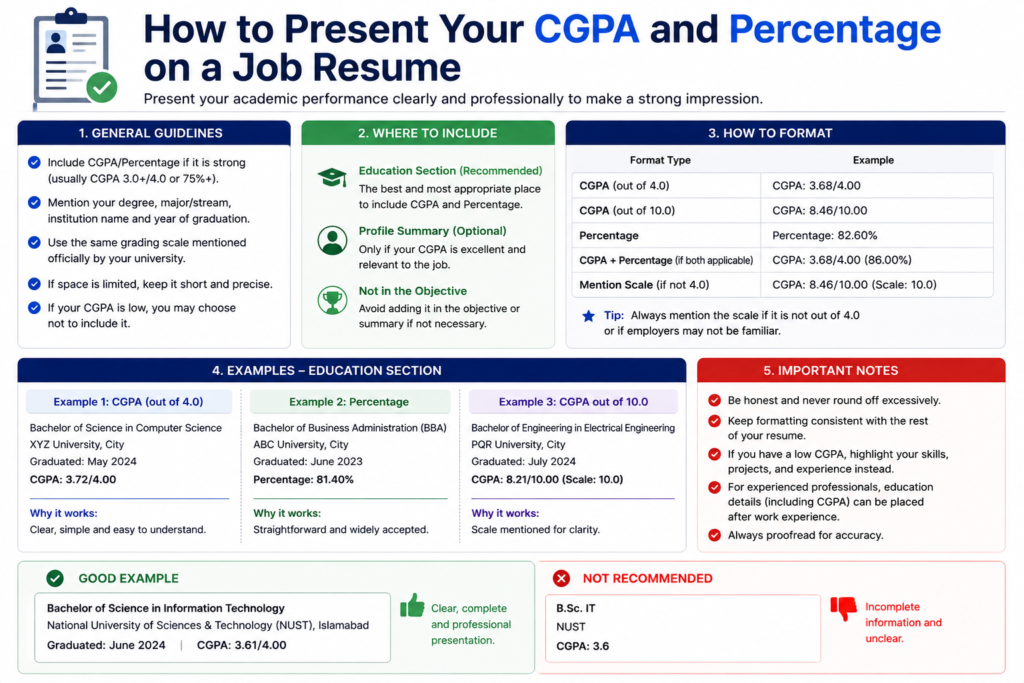
Recruiters spend seconds, not minutes, on a first resume scan — which means how you present your CGPA or percentage can matter almost as much as the number itself. Format it awkwardly, and a strong score gets lost. Include it without thinking, and an average score can draw more attention than it deserves. This guide gives you a clear, practical framework for getting it right.
Should You Include CGPA, Percentage, or Both?
The short answer: include whichever number your target employer or industry is more likely to understand and expect, and only include both if you have space and it adds clarity rather than clutter.
- If you’re applying within a system where CGPA is the standard (most Indian universities, for example), lead with CGPA.
- If you’re applying somewhere percentage is more commonly expected (some traditional recruitment processes, especially for entry-level government or public-sector roles), lead with percentage.
- If you’re applying internationally where neither is the local norm, consider a brief GPA-equivalent note (see the international section below) rather than assuming the recruiter knows how to interpret a 10-point CGPA scale.
How to Format CGPA and Percentage on a Resume
Keep it short, in the education section, right next to your degree and institution — not in a separate section, and not buried in a paragraph.
Formatting Examples
| Format | Example |
|---|---|
| CGPA with scale shown | B.Tech Computer Science — CGPA: 8.4/10 |
| CGPA without scale (only if universally understood in your context) | B.Tech Computer Science — CGPA: 8.4 |
| Percentage | B.Com — Percentage: 82% |
| Both (only if space allows and it adds real clarity) | B.Sc Physics — CGPA: 8.7/10 (Percentage: 82.6%) |
Always show the scale for CGPA (e.g., “/10”) unless you’re certain the reader already knows your institution’s scale — a bare “8.4” without context can be misread by someone used to a 4.0 scale.
Should You Include a Low CGPA or Percentage?
This is the question with the most genuine anxiety behind it, and there’s no single universal answer — but here’s a practical framework.
A Simple Decision Framework
- You’re a fresher (0–2 years experience) applying to roles where academic performance is explicitly part of the screening criteria (e.g., campus placements, some graduate programs): including it is often expected, even if it’s average — omitting it can itself raise a flag.
- You’re a fresher applying to roles where academics aren’t emphasized (many creative, sales, or skills-first roles): a genuinely low score can often be omitted in favor of leading with projects, skills, or internships instead.
- You have 3+ years of experience: academic scores generally carry far less weight than your work history at this stage — many experienced professionals drop CGPA/percentage from their resume entirely, regardless of what the original number was.
If you do choose to omit it, don’t draw attention to the omission — simply list your degree and institution without a score, which is a normal and unremarkable resume convention once you have meaningful work experience.
Where on the Resume Should It Go?
Directly within your education section, on the same line or immediately following your degree name and institution — not in a summary, skills section, or separate “achievements” block, where it can look out of place or overly emphasized.
Do Recruiters Actually Care About CGPA After Experience?
For early-career roles, many employers do factor CGPA into initial screening — particularly for structured graduate/campus recruitment processes. But as work experience accumulates, most recruiters weight actual job performance, project outcomes, and skills far more heavily than an academic score from years earlier — which is part of why dropping it from an experienced resume is such a common and accepted practice.
International Applications: Should You Convert Your CGPA?
If you’re applying to a country where GPA (not CGPA) is the standard, a brief conversion note can help a recruiter unfamiliar with a 10-point scale — for example, “CGPA: 8.4/10 (approx. 3.4/4.0 GPA).” Use our GPA to CGPA Calculator to get that approximate figure. Label it clearly as approximate — don’t present a self-converted number as an official equivalence, especially if the application process also involves a formal credential evaluation elsewhere in your application.
Common Mistakes
- Listing CGPA without specifying the scale (e.g., “8.4” with no “/10”), leaving the reader to guess
- Including a low score without any strategic reasoning, when omitting it might have served better
- Placing the score in an odd location on the resume (a separate “achievements” section, or in the summary) rather than directly in the education section
- Presenting a self-converted international GPA equivalent as if it were an official evaluation
FAQs
Should I put CGPA on my resume? Generally yes for early-career applicants, especially when applying to structured recruitment processes that screen on academics — for experienced professionals, it’s increasingly common (and acceptable) to omit it.
What if my CGPA is low — should I still include it? It depends on your career stage and the role — freshers applying to academically-screened roles are often expected to include it regardless, while those applying to skills-first roles or roles further into their career can reasonably choose to omit a low score.
How do you write CGPA correctly on a resume? Include the scale (e.g., “8.4/10”) directly next to your degree and institution in the education section, so the reader doesn’t have to guess which grading scale you’re using.
Do companies verify CGPA from resumes? Many companies, particularly for structured recruitment or background verification processes, do request official transcripts or mark sheets to verify the figure listed — so always list your actual, accurate score rather than rounding favorably.
Key Takeaways
- Lead with whichever number your target employer or industry expects — CGPA, percentage, or occasionally both
- Always show the scale for CGPA (e.g., “/10”) so it isn’t misread
- Whether to include a low score depends on your career stage and the role’s emphasis on academics — there’s no single universal rule
- For international applications, a labeled approximate conversion can help, but never present it as an official equivalence
Related Tools
- CGPA Calculator
- Percentage to CGPA Calculator
- GPA to CGPA Calculator
Call To Action
Not sure of your exact CGPA or percentage yet? Use our free CGPA Calculator or Percentage to CGPA Calculator to get the precise number before you update your resume.
Leave a Reply