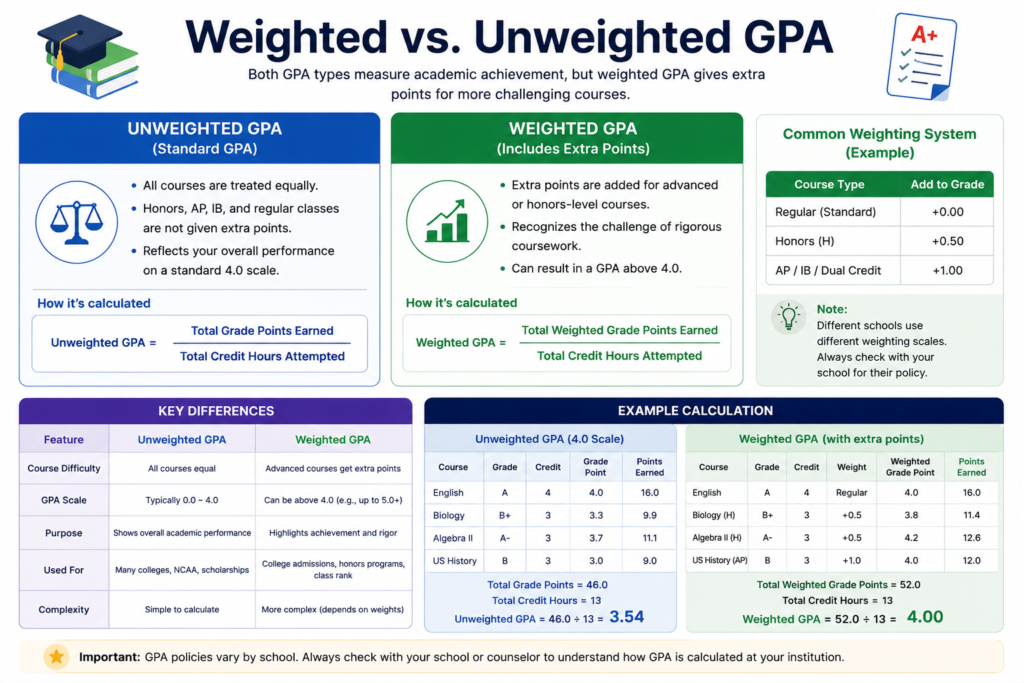
Two students can take a completely different course load, earn the exact same grades, and still walk away with two different GPAs — just because one of them took AP Chemistry and the other took regular Chemistry. That’s the entire point of weighted GPA, and it’s also the reason so many students see a 4.3 or 4.6 GPA and assume something’s broken. Nothing is — it’s just a different scale, measuring something a little different than the GPA you probably learned first.
Unweighted GPA: The Baseline
Unweighted GPA treats every course the same, regardless of difficulty. An A in gym class and an A in AP Calculus are both worth the same 4.0. The scale tops out at 4.0, full stop.
This makes unweighted GPA useful for one specific job: comparing students on a level playing field, since it strips out any difference in course difficulty.
Weighted GPA: Rewarding Harder Courses
Weighted GPA adds extra points for courses considered more rigorous — typically AP, IB, or Honors classes. The exact bonus varies by school, but common patterns are:
- +1.0 point for AP or IB courses (so an A becomes a 5.0 instead of a 4.0)
- +0.5 point for Honors courses (so an A becomes a 4.5 instead of a 4.0)
- Regular courses stay on the standard 4.0 scale
This is why weighted GPAs can exceed 4.0 — sometimes reaching 4.5, 5.0, or higher depending on how many advanced courses a student takes and how their school structures the bonus.
Side-by-Side Example
Say a student takes four courses in a semester:
| Course | Grade | Unweighted Points | Weighted Points |
|---|---|---|---|
| AP Biology | A | 4.0 | 5.0 |
| Honors English | A- | 3.7 | 4.2 |
| Regular Algebra II | B+ | 3.3 | 3.3 |
| Regular Spanish | A | 4.0 | 4.0 |
Unweighted GPA: (4.0 + 3.7 + 3.3 + 4.0) ÷ 4 = 3.75 Weighted GPA: (5.0 + 4.2 + 3.3 + 4.0) ÷ 4 = 4.13
Same courses, same grades — but the weighted number gives credit for the two advanced classes, while the unweighted number doesn’t distinguish them from the regular-track courses at all.
Why Do Both Numbers Exist?
Colleges genuinely want both pieces of information, for different reasons:
- Unweighted GPA lets admissions officers compare applicants from different high schools on equal footing, since not every school offers the same number of AP or IB courses.
- Weighted GPA shows how much a student challenged themselves within the courses actually available to them.
Most competitive college applications ask for — or recalculate — both. Some colleges even apply their own weighting formula on top of your transcript, disregarding whatever your high school used, specifically so every applicant is judged by the same yardstick.
How to Calculate Your Weighted GPA
- List every course you’ve taken, along with its letter grade and course type (Regular, Honors, AP/IB).
- Convert each grade to points, applying the bonus for Honors (+0.5) or AP/IB (+1.0) courses — check your school’s specific policy, since bonus amounts vary.
- Add all the weighted points together.
- Divide by the total number of courses to get your weighted GPA.
If you’re doing this across multiple semesters, treat every course from every semester as one combined list rather than averaging semester GPAs together — otherwise semesters with more courses won’t be weighted correctly against semesters with fewer.
A Common Mistake: Comparing the Two Numbers Directly
It’s tempting to look at a 4.5 weighted GPA next to a 3.9 unweighted GPA and think the weighted number is simply “the real one” or the bigger accomplishment. But they’re not measuring the same thing, so they shouldn’t be compared to each other at all — only to other students’ numbers calculated the same way. A 4.5 weighted GPA at a school that adds +1.0 for AP courses isn’t directly comparable to a 4.5 weighted GPA at a school that adds +0.5, even though the number looks identical on paper.
Calculate Yours Instantly
Doing this by hand across four years of transcripts is where small errors creep in — a missed Honors bonus here, a mis-added semester there. Our Weighted GPA Calculator handles both weighted and unweighted GPA at once: enter your courses, grades, and course type, and it computes both numbers live so you can see exactly how much the weighting is adding.
FAQ
Is a 4.0 unweighted GPA better than a 4.3 weighted GPA? They can’t be compared directly — a 4.0 unweighted GPA means straight A’s in every course, while a 4.3 weighted GPA depends entirely on how many advanced courses were taken and how the school weights them. Admissions officers evaluate both numbers in context, not as directly interchangeable figures.
Do colleges prefer weighted or unweighted GPA? Most ask for both, and many recalculate your GPA using their own formula regardless of what your transcript shows — so neither number alone tells the whole story.
Why is my weighted GPA lower than I expected? Double-check which courses your school actually classifies as Honors, AP, or IB — a course you consider “advanced” may not carry a bonus under your specific school’s policy.
Can weighted GPA exceed 5.0? It’s uncommon but possible at schools with unusually generous weighting systems or a heavy load of dual-enrollment college courses — always check your school’s specific scale rather than assuming a standard cap.
Leave a Reply